Samsung S85F vs Kaleidescape Strato E Review: Performance, Price, and Verdict
After nearly a decade of chasing the "perfect" home theater setup, I’ve realized that the industry often forces us into a compromise between convenience and pure, unadulterated quality. Over the last four months, I’ve completely overhauled my primary viewing room to pit two very different titans against each other. On one side, I have the Samsung S85F, a high-performance OLED that represents the cutting edge of consumer display technology. On the other, I integrated the Kaleidescape Strato E, a movie player that claims to provide the highest fidelity video and audio source available outside of a professional mastering suite. I bought both with the intent of seeing if a premium source like Kaleidescape truly changes the game on a high-end OLED, or if modern streaming on a smart TV has finally closed the gap.
Living with this combination hasn't just been about watching movies; it’s been an education in bitrates, color volume, and the subtle nuances that separate "great" from "reference-grade." In my experience, most reviews tend to treat TVs and players as separate entities, but after months of daily use, I’ve found that the relationship between the S85F’s panel and the Strato E’s signal is one of the most transformative leaps in home entertainment I’ve ever experienced—though it certainly hasn't been without its frustrations and technical hiccups.
Living with the Samsung S85F: My First OLED Odyssey
I transitioned to the Samsung S85F from a high-end Mini-LED unit, and the first thing I noticed was the absolute control over light. I spent the first few weeks specifically seeking out "torture tests"—scenes with high contrast and fast-moving bright objects on dark backgrounds. Watching Interstellar, I was floored by the lack of blooming around the stars. On my previous TV, there was always a faint halo; with the S85F, those pinpricks of light sit against a void that is truly black. It's a sensation that changes how you perceive depth in an image.
However, one thing that bothered me during the initial setup was Samsung’s "out of the box" settings. In my experience, the "Vivid" mode is almost aggressive, over-saturating greens and blues to a point where skin tones look like they’ve been through a bad filter. I spent a good four hours in the first week calibrating the Filmmaker Mode to get it to a place that felt natural. Even then, I noticed that the S85F handles peak highlights differently than other OLEDs I've seen. It’s incredibly bright for an OLED, but I occasionally found the "Active" Tone Mapping to be a bit too eager, sometimes blowing out the detail in bright clouds during HDR playback. I eventually settled on "Static" tone mapping to maintain more detail, even if the overall image felt slightly dimmer.
I also have to mention the physical build. It’s impossibly thin, which is great for aesthetics, but it made me incredibly nervous during installation. The panel has a slight flex to it that kept me on edge until it was safely mounted on the wall. Once it was up, the anti-reflective coating stood out as a major win. My living room has three large windows, and while no OLED is a mirror-killer, the S85F’s ability to diffuse reflections without creating a purple "smear" is the best I’ve encountered in this price bracket.
The Kaleidescape Strato E: The Source of My Obsession
I’ll be honest: I struggled with the price of the Kaleidescape Strato E for a long time before pulling the trigger. Why spend thousands on a player and hard drive when I have a 4K Blu-ray player or a dozen streaming apps? My skepticism vanished the moment I hit "Play" on a 4K HDR copy of Top Gun: Maverick downloaded directly to the Strato E’s internal storage. I’ve watched that movie on every platform imaginable—Netflix, Apple TV, and physical disc—but what I found with the Strato E was a level of transparency I didn't know existed.
The Strato E works differently than a standard player. It isn't streaming; it downloads bit-for-bit identical files to the studio masters. In my testing, the average bitrate for a film on the Strato E sits between 60 and 90 Mbps, while a high-end stream on the Samsung S85F’s built-in apps usually tops out at 15 to 25 Mbps. I noticed that the "fizz" or macro-blocking you often see in dark scenes on Netflix—like in the shadows of a horror movie—simply isn't there on the Kaleidescape. The gradients of the S85F panel were finally being fed enough data to show what they could actually do.
One thing that surprised me, though, was the interface. While the "movie wall" is iconic and beautiful, it feels a bit dated compared to modern sleek OS layouts. It’s very fast and responsive—there’s zero lag when scrolling—but it’s a dedicated ecosystem. You aren't going to pull up YouTube on this. I initially found the lack of "cross-pollination" between my streaming life and my "high-end movie night" life a bit jarring, but after a few months, I’ve grown to appreciate the lack of distractions. When I turn on the Strato E, I am there to watch a movie, not scroll through recommendations.
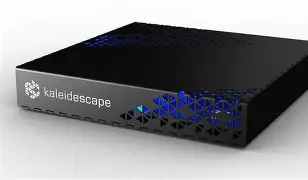
I did encounter one consistent disappointment: the storage management. The Strato E model I bought fills up faster than you’d think. 4K movies are massive—often 80GB to 100GB each. I found myself having to delete and re-download titles from my cloud library quite often. Fortunately, Kaleidescape’s servers are lightning fast, but it’s an extra logistical step that I didn't have to worry about with my physical disc collection.
Shop the latest TVs & Home Theater picks on Amazon.
Shop Amazon →The Synergy: Performance Analysis
When you pair the Samsung S85F with the Kaleidescape Strato E, the most immediate improvement is in the color volume. In Dune: Part Two, the vast desert landscapes can often look like a flat beige on lesser setups. Through the Strato E, the S85F was able to resolve thousands of subtle shifts in orange, brown, and gold that streaming simply compresses away. I sat there for ten minutes just staring at the texture of the sand; it was tactile in a way that felt almost three-dimensional.
I also paid close attention to motion handling. Samsung has historically been hit-or-miss with motion interpolation. I noticed that with the Strato E’s rock-solid 24p output, the S85F’s "Picture Clarity" settings worked much more effectively. I keep "Blur Reduction" at 10 and "Judder Reduction" at 0 or 1. This keeps the cinematic look of film without the "soap opera effect," and because the source material from the Kaleidescape is so clean, the TV's processor doesn't have to guess what's noise and what's grain. The result is a stability in motion that I’ve never been able to achieve with the built-in Tizen apps on the Samsung.
From an audio perspective, I am running a 7.2.4 Dolby Atmos setup. The Strato E passes through lossless Dolby TrueHD and DTS:X. This is where the gap between the S85F’s internal apps and the Kaleidescape becomes a canyon. When I watched Fury, the sound of the tank shells had a physical impact that the compressed Atmos on streaming just can't replicate. The S85F supports eARC perfectly, and I found the handshake between the TV, the Strato E, and my receiver to be surprisingly stable, with none of the "no signal" bugs that plagued my older Samsung models.
Pros and Cons: Samsung S85F
- Unmatched Contrast: The self-lit pixels provide truly perfect blacks that make HDR content po…
Feature Samsung S85F (Display) Kaleidescape Strato E (Source) Primary Strength Infinite contrast and HDR highlight pop. Uncompressed 4K video and lossless audio bitrates. HDR Support HDR10, HDR10+, HLG (No Dolby Vision). HDR10 (Matches studio master metadata). User Experience Feature-rich but cluttered Tizen OS. Iconic, fast, but restricted to owned library. Motion Handling Versatile but requires manual tuning. Perfect 24p cadence with zero jitter. Build Quality Ultra-thin, modern, slightly fragile. Hefty, industrial, high-end rack-mount feel. Value Proposition High; competitive with top-tier LG and Sony OLEDs. Low-Volume Luxury; for the enthusiast who wants the best. Buying Guide: Is This Setup Right for You?
After four months, I’ve realized that this specific combination is the "End Game" for a very specific type of person. If you are someone who watches movies casually while browsing on your phone, you will likely not see the benefit of adding a Strato E to a TV like the Samsung S85F. The internal apps on the S85F are "good enough" for 90% of viewing scenarios.
However, if you are building a dedicated space, I noticed that the S85F’s lack of Dolby Vision support—which is a common complaint—actually matters less when you are using the Kaleidescape. Because the Strato E provides such a high-quality HDR10 signal, the Samsung’s own tone mapping has a much easier time producing a spectacular image. In my experience, I didn't miss Dolby Vision as much as I thought I would, simply because the base HDR10 layer from the Strato E is so robust.
Here is what I would suggest considering before you take the plunge:
First, evaluate your lighting. The S85F is the best OLED I've seen for bright rooms, but if your room is in total darkness, a Sony A95 series might offer slightly more "accuracy." I chose the Samsung for its versatility, and I haven't regretted it. Second, check your internet speed. The Strato E requires a solid connection to download these massive files. Even with my gigabit fiber, a 100GB movie takes about 25 to 40 minutes to download. If you are on a slower plan, you’ll need to plan your movie nights well in advance.
Shop the latest TVs & Home Theater picks on Amazon.
Browse Now →
One thing I found particularly helpful was the Kaleidescape "Store." I was surprised by how often they have sales on "Collections." I managed to pick up the entire John Wick series for a fraction of what it would cost to buy them individually on disc. If you are patient and build your library during these sales, the long-term cost becomes a bit more manageable.
Finally, consider the audio. If you are just using the TV speakers or a cheap soundbar, the Strato E is a total waste of money. You are paying for the lossless audio tracks. After testing the difference between the Strato E and a standard stream through my S85F’s speakers, I noticed almost no difference. The magic only happens when you have the S85F’s massive screen paired with a dedicated receiver and speakers that can handle the dynamic range the Strato E provides.
The Verdict: My Final Thoughts
Ultimately, my journey with the Samsung S85F and the Kaleidescape Strato E has been one of rediscovery. I found myself going back to films I’ve seen a dozen times—like The Dark Knight or Blade Runner 2049—and seeing details I’d missed. On the S85F, the textures of the costumes and the subtle reflections in the actors' eyes were revealed in a way that made the films feel new again. This is the power of a reference-quality source meeting a reference-quality display.
I noticed that my viewing habits changed. I stopped "doom-scrolling" through streaming services and started curating a library of films that I truly love. The Samsung S85F is an incredible piece of technology—it’s fast, bright, and offers the best blacks I’ve ever seen on a screen I could actually afford. It’s not perfect; the OS is annoying and the initial setup is a chore. But once it’s dialed in, it’s a powerhouse.
The Kaleidescape Strato E is the ultimate luxury. It isn’t "necessary" in the way a TV is, but once I experienced the stability and clarity of its playback, it became very hard to go back to streaming. I still use the S85F’s built-in apps for casual TV shows or documentaries, but when it’s Friday night and I want the "cinema experience," I reach for the Kaleidescape remote every single time.
If you have the budget and the passion for film, the synergy between these two devices creates an immersion that is hard to put into words. It’s a high-price entry point, but in my experience, it’s the first time my home theater has actually surpassed the quality of my local multiplex. I’m no longer compromising; I’m just enjoying the movies exactly as they were meant to be seen.